
This post is 100% AI free. After almost three years (feels MUCH longer) I have left Farmless. While I love the intensity of working at a startup, it is - at least for me - not a great match with having three young kids at home. And nope, I don’t know yet what I’ll be doing next.
With all this out of the way, let me tell you the Farmless story.
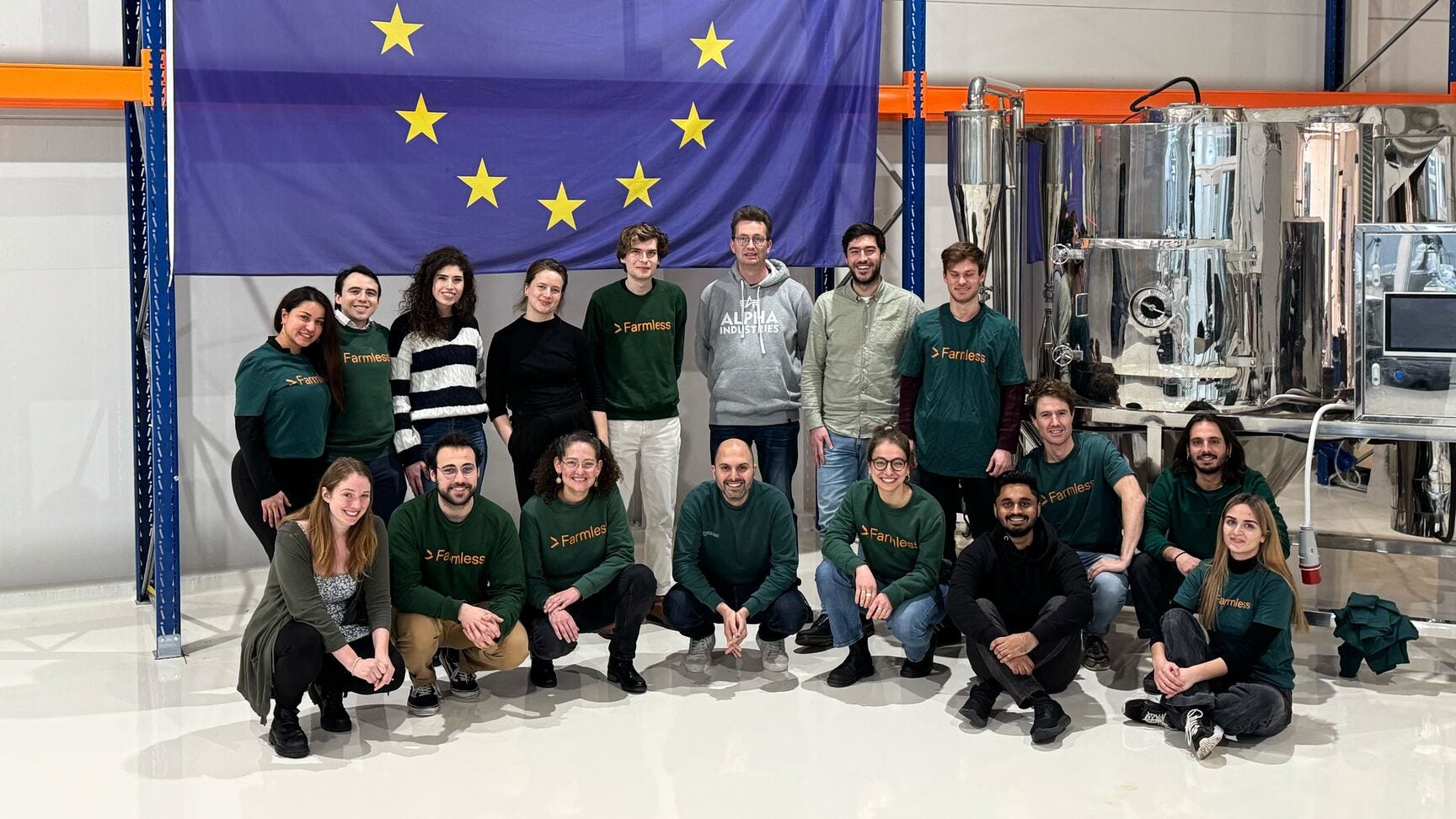
The adventure began with a walk around the Sloterplas lake in Amsterdam with Adnan Oner on a cold overcast afternoon in December 2022. I had just published a longread about the future of agriculture for De Groene Amsterdammer and Adnan’s dad, who spells out every edition, had forwarded it to him. Adnan wrote me a message on Linkedin that he loved the longread, had in fact just started a fermentation company and that he might need some help on the communication side. We also happened to both live next to the Sloterplas.
(One piece of advice I consistently give to people that want to enter a new field is that they should write in public about their quest. This will leave a trail of breadcrumbs around the internet that will almost guarantee that the right people can track you down - eventually.)
During the hour long walk we found out that we agreed on many fundamental things. We are both optimists in the Deutschian sense of the word (the only limitations to human creativity being the laws of physics). Crucially, we agreed that the current agricultural setup with its pesticide sprayed monocultures, industrial scale animal abuse and its reliance on a flawed energy conversion mechanism (photosynthesis) is a bottleneck for humanity.
We also agreed on the enormous opportunity here, because photosynthesis and protein production through animals are so far removed from the limits of physics. Brewing proteins using fermentation is a promising way forward to open up a wild new frontier of agriculture. The holy grail is to build a fermentation stack on top of energy instead of photosynthesis - in other words, the approach that Farmless is taking. Fermentation done well would be on par with history-altering inventions such as the Haber Bosch process (synthetic fertilizer) and the Newcomen atmospheric engine (steam power). If we can create dramatically more food with less land, under perfectly controlled conditions, this will bring about 1) food security and 2) unlock massive tracts of land. Roughly half of the habitable land on the planet is currently used for agriculture — how amazing would it be to use this land for more animal friendly regenerative farming, rewilding and reforesting and more cities and villages? There are much better uses of land than endless hectares of soy monocultures!
(Personally I’ve always cherished a third reason: if we can master energy based fermentation, it increases the likelihood of a self sustaining city on Mars. I strongly believe we should not replicate factory farming on other planets.)
Anyways, what convinced me on the spot during that walk was that Adnan had done his homework. Every question I asked he could answer instantly. Turned out that he had spent several years to read *all* the papers, doing *all* the fundamental math and physics himself and talked to *all* the experts in the field. He understood the first principles of food production so well that I think he had switched to just seeing energy flows instead of sunshine, meadows and cows. It was exactly this hard work that had led him to correctly identify the right microbial culture that Farmless is currently domesticating! (The choice of microbial culture turned out so important in so many ways - from logistics to unit economics to brewery design to taste and texture - it really is the secret sauce of Farmless.)
After the walk we shook hands and I agreed on joining Farmless as head of communications. I did not know yet that telling good stories was going to be a minor part of the actual job.
Many hats
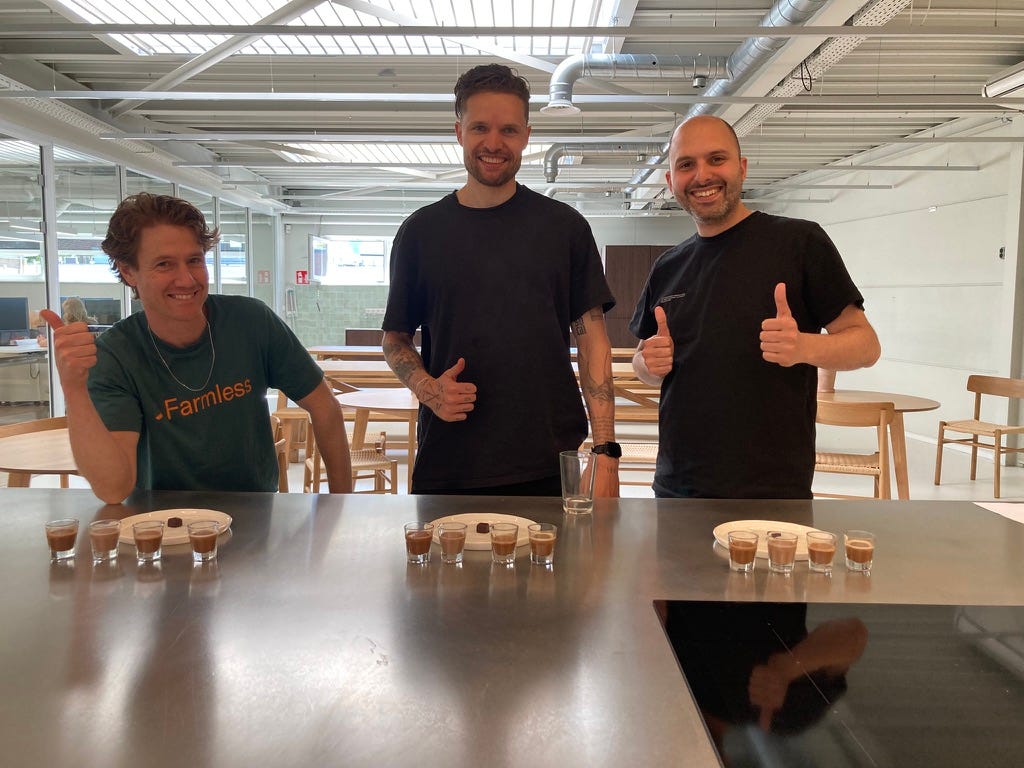
As in most startups, early employees wear many hats. I knew this because I was an early employee in another startup - Fastned - but I had not expected I would be running public affairs, operations, HR and onboarding, searching for and renovating a new headquarters, organising off sites, setting up an employee stock option plan, getting the compensation plan right and addressing basically any other urgent problem that popped up. At our new headquarters I also helped to set the vibe for the Farmless cafe, the Farmless gym and the library.
Lucky break
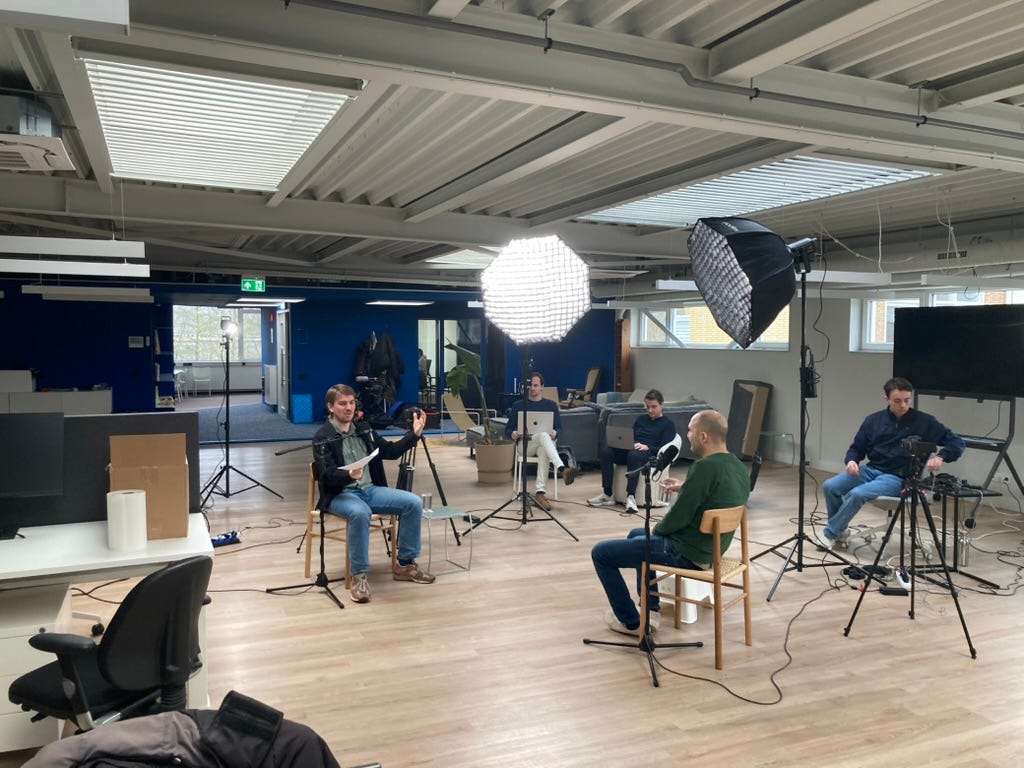
After just a few months we got out in the open with our wild story about energy based fermentation. De ‘Rudi and Freddie show’, a popular but nerd skewing Dutch podcast, asked Adnan on their show. There was instant nerd bravado chemistry between Adnan, Rutger Bregman and Jesse Frederik. The interview was long winded with lots of facts and scientific ideas but the people who listened to it loved it! I *still* meet people who say they know Farmless via this podcast.
Starting a cult
A startup story cannot be distilled in a formula. But at a minimum I think it should communicate 1) ambition and 2) a positive vision of success 3) a form on first principles thinking — which most often will sound counter-intuitive to most people, which will make them curious. Taken together, these claims should feel close to a religion or a cult with a secret about the world at its core. This helps to forge individuals into a tight group: because of the shared grand mission and the powerful “us against the received wisdom” mindset. A powerful startup story is also a self-fulfilling prophecy: the right people and the right investors will magically find out about you.
American startups usually excel in telling these stories. They do the hard work of writing down and visualising what they want to achieve and how to best communicate that vision. Most European hardware startups - despite their technical chops - don’t do that (yet). I realised this when I helped to create HARDLIST, a website that lists the most ambitious European hardware startups. It is frustrating to see how poorly many startups manage to get their brilliant ideas across. There’s no easy solution to this, as European founders somehow think they shouldn’t be creating cults. But they should think of themselves more as founders of religions.
Building the dream team
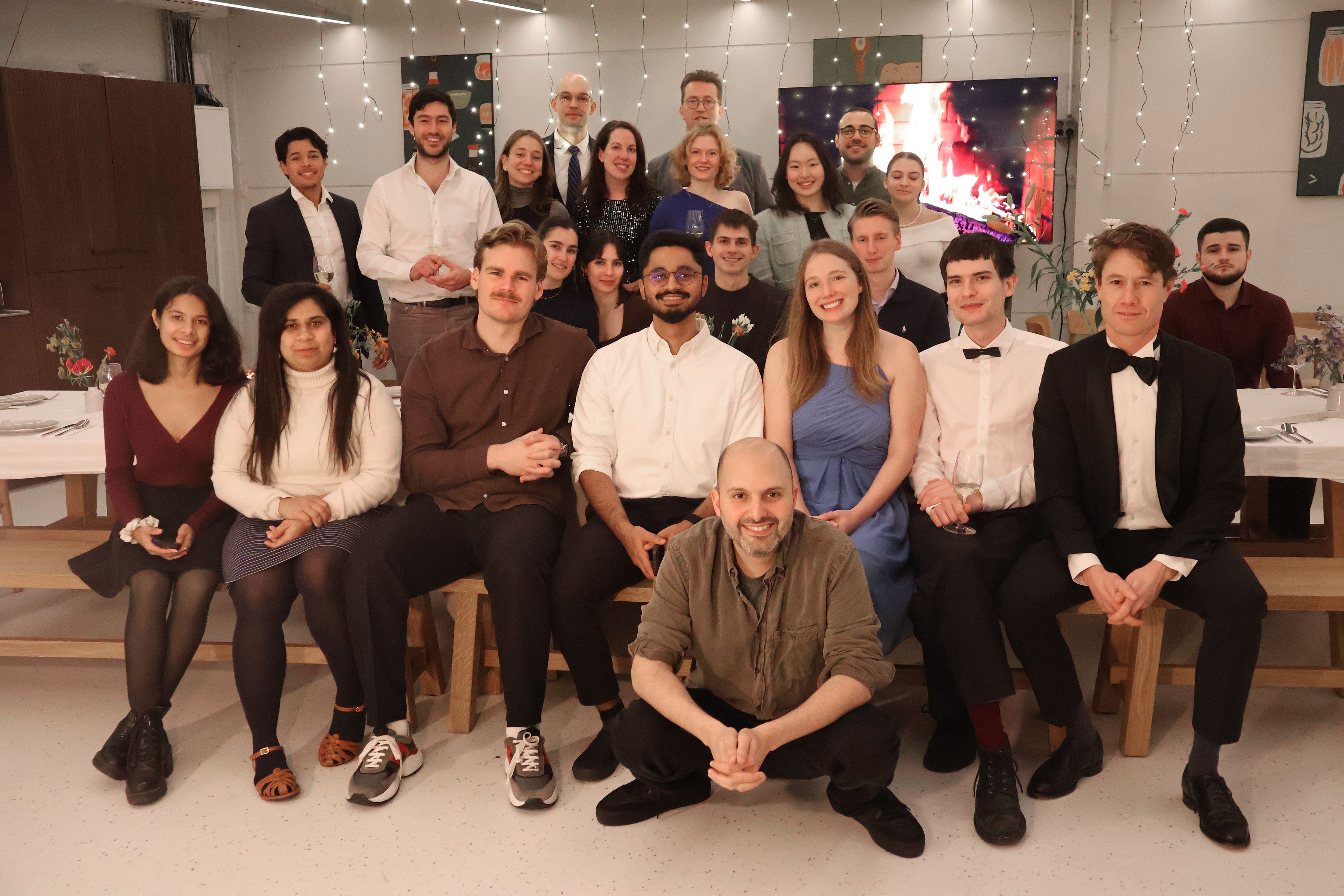
What I enjoyed most about my time at Farmless was building out our “dream team”. After a year of publicity Farmless was becoming a somewhat known brand. (This was mostly the result of press attention of the pre-seed and seed rounds. High quality venture capital backing can act as another self-fulfilling prophecy.) This led to a spike in interests in the vacancies we posted online with many garnering over a hundred quality applicants from all over the world. I felt I was a kid in the candy store, picking my future colleagues from this firehose of applicants that was suddenly aimed at us. Adnan and I had long discussion about what kind of person we should optimise for. Big plusses for me are: do I feel energised after talking to this person? Are they asking the right questions? Does it feel like a conversation instead of an interview? What is their level of obsession? We also select people that exhibited some Renaissance (wo)man qualities.
Sometimes we got lucky and accidentally hired people with skills we did not realise we would need later on. A great example is Jordan Radek who moved from the US to Amsterdam to become our fermentation lead. She turned out to be not just an excellent fermentation lead, but a natural teacher and communicator. This has been of tremendous value for Farmless because of our high intern throughput.
At the moment I’m writing this we have fermers from the US (4 of them!), China, India, Brazil, Hungary and Germany. The Dutch are a minority. Hiring people from all over the world is a cheat code because these hires are often hungry for success — you don’t fly across the world just to start slacking in Amsterdam. This high density of hungry talent in turn leads to a critical mass of people, setting off a chain reaction of energy which is magical to witness. The Netherlands - and perhaps Amsterdam in particular - is still very good at attracting talent from all over the world - including Americans! Needless to say, I’m 100% pro immigration of talented hard working people and the ability to attract these rare people is a competitive edge the Netherlands should be CULTIVATING - but this is a topic for another post…
Hiring lessons
It took about two years but hiring people is something we - I must say, mostly Adnan - got really good at. At one point we realised that in order to get certain highly technical people on board we could not rely on them finding us, we needed to find THEM. Adnan started spending hours on end combing through Linkedin until he had a complete picture of *everyone* who would fit the bill and then started calling them. This works surprisingly well because everyone is flattered when the CEO / founder of a startup personally reaches out to them.
Another thing we had to learn from scratch was calibrating the compensation offers. What has worked well was giving people just two good offers (thanks Salar!) One offer has a lower base salary and more equity and the other has a higher salary and less equity. This has reduced the time we’re spending on salary negotiations by something like 10X and in most cases people would choose more equity, which is a motivating start for everyone!
Raising the bar
The first thing I noticed on my first work day with Adnan was the speed he blasted through his windows on his computer screen. I considered myself a nerd, but when I saw the way Adnan was handling his screens like Neo in the Matrix… my self image was shattered. He didn’t touch his mouse, used a ton of shortcuts and had a program called “Alfred” (now replaced by Raycast). I realised that I was WAY behind- what had I being doing these past decades? I vowed on that day that I was going to master this as well. For the next months I was memorising shortcuts. I’m still not as fast as Adnan, but now I’m the one who looks wary when I see other people over-using their mouse. Being in a team with people that have some exceptional skill (sub)consciously led me to up my game.
Apart from Adnan’s speed and impatience Farmless is exceptional in a couple of other areas: frugality (a lot of our brewing equipment is bought from auctions or we got it for free, we bargain over every large purchase, most stuff in our office is bought second hand), openness in discussing ideas (Adnan claims he ‘cannot be insulted’ — turning down the ego volume in a team increases the flow rate of ideas), and first principles thinking (“what does physics have to say about this?” is a recurring theme). One other thing that makes Farmless stand out and is the wholesome practice of DIY lunch preparations. We cook our own, totally awesome plantbased lunches from scratch pretty much every day! I have never seen this before anywhere else. I recently figured out that it actually makes sense in a startup environment because chopping onions and carrots is a meditative moment in the middle of a hectic day.
What is next
Where does Farmless stand now? Well, we’ve come a long way. We vertically integrated the whole damn protein production process. Molecules go in and a milkshake comes out - under a single roof. In other words, it works. Because all the key processes take place in one building, the company acts as a single feedback loop — which ensures maximum learning speed. We have people from all disciplines and trades, with backgrounds varying from The Vegetarian Butcher and Perfect Day to hardcore fermentation experience at DSM and Lanzatech.
The next step for Farmless - the proof of the pudding - will be building its first commercial, large scale brewery. I hope this thing is going to be built in the Netherlands. Fermentation really is the next frontier in agriculture and one that the Netherlands can dominate. The Netherlands is an agricultural powerhouse with world class seed production, greenhouse yields that are off the charts and a long history of land reclamation. Fermentation is simply the next iteration towards more predictable, higher yields, needing less inputs and causing less environmental damage. Fermentation is a game that the Netherlands should play to win.
Great read Pepijn! I like your comparison to the Haber Bosch process, which I learned about through your recommendation of "The Alchemy of Air". For a next post on cultivating a competitive edge in the Netherlands through immigration, reading "Peak Human" by Johan Norberg might be interesting inspiration.
Interesting behind-the-scenes look at a deep-tech food startup, Pepijn. Sorry to hear you’re leaving Farmless; I can imagine that pace is brutal with three young kids.
Maybe this also frees you up to finally launch that sensible, optimistic centrist political party in the Netherlands 😉
And I’m curious: why the “100% AI-free” note? What’s your objection to using AI for drafting/editing a post like this?